


What you hold in your hands is the five-year anniversary issue of CODE Magazine. How significant is that? We think it is very significant, and probably more so than other five-year anniversaries. Here's why: CODE Magazine is a small organization (a division of EPS Software Corp - www.eps-software.com - a relatively small custom software and consulting company) and we are therefore up against huge competition! And this is a tough business to be in. The vast majority of new magazines never make it beyond the first few years.
That is certainly what our competitors prophesized for CODE years ago. Competitors tried to belittle us. Advertisers wanted to wait and see “whether we'd still be around a year later.” Even some authors were skeptical at first. But there was one group of people that have always stuck with us and were enthusiastic about what we were doing: The readers! And that's what always counted for us. Overall, the endeavor of a software company turning publisher has worked out much better than large publishers trying to understand software development. We believe that we are the leaders in independent content delivery for .NET developers today, and readers seem to con-firm that by rating CODE Magazine articles an average of 4.18 stars out of a possible 5!Across the board, over all 5 years!
So how did we get here? Here's a brief history of how things started out.
Premier Issue Pre-Production
The first issue of CODE Magazine appeared in spring of 2000. Before that could happen, however, we had a lot of up-front work that needed to be done. So in a lot of ways, CODE Magazine came into existence in1999. At that time, .NET had not even been announced and people were worried about the Y2K problem. People were working in COM and (many of them) in pre-COM environments. In that light, the people working at CODE Magazine had a new idea that many doubted would work: create a language-independent magazine that would not focus on a language like VB, C++, or VFP, but on the platform and technologies instead. When talking about that idea, we often said that, “Once COM+ gets released, it will not matter what language you use to program queued components. Instead, you will focus on how queued components are developed in more general terms.” Windows DNA showed that concept to be correct, and .NET drove that point home more impressively than any environment before.
Spring 2000
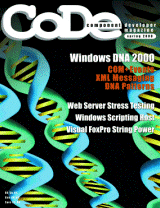
Our first issue focused on a revolutionary concept: “Windows DNA2000.” This issue's articles discussed XML messaging, COM+ events, Web server stress testing, and other Windows DNA-related subjects.We provided CODE samples mostly in VB6and VFP at the time. We also had an article about VFP string performance.
Summer and Fall 2000
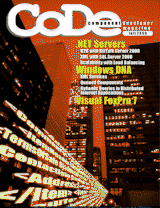
These two issues continued many of the same concepts as Spring 2000 - Windows DNA everywhere. Our cover articles also included COM+ security and queued components. XML messaging was big in both issues. In a way, Windows DNA seems so distant now. On the other hand, developers had to tackle many of the same problems they are tackling today. Security and message-based programming were, and continue to be, hot topics (although both subjects have taken on a drastically different appearance today).
Issue 1 - 2001
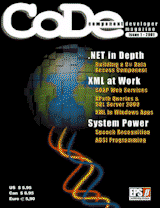
After we managed to thoroughly confuse our readers and subscribers from the Southern hemisphere by releasing a “Fall” issue in their summer, we decided to change the way we labeled the magazine. The first issue in 2001 concerned itself with “.NET in Depth.” We had our first C# article. In addition, we covered more XML, including Web services. We also thought speech recognition was an important subject. We still think so today although we would have predicted more progress in that area.
Issue 2 - 2001
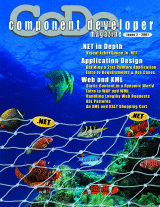
Big changes came in this issue. For the first time, CODE Magazine had a dedicated editor (David Stevenson).We were also gearing up to switch from quarterly to bi-monthly distribution. Content started to be more .NET-oriented because we could definitely see that technology on the horizon (if you had good binoculars).
Nov/Dec 2001
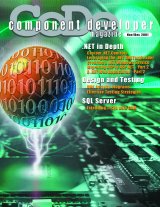
While our friends from the Southern hemisphere were happy with the new cover numbering scheme, we had now succeeded in confusing ourselves as well as our distribution partners. We were on a bi-monthly schedule so we decided it would be better to put the month on the cover, hence the name “Nov/Dec 2001.” We still use that naming convention today.
March/April 2002
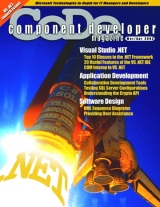
Another milestone issue for CODE Magazine! We named Rod Paddock Editor-in-Chief (David Stevenson moved up to Associate Publisher). For the first time ever, CODE Magazine was available in newsstands around the country! (The very first issue ever sold on newsstands and its receipt is still displayed in the office at EPS.) Our content was heavily .NET-oriented, although we discussed lots of “current day” technologies as well. Readers loved it, and we managed to establish ourselves on newsstands. A major hurdle most magazines never make.
Sep/Oct 2002
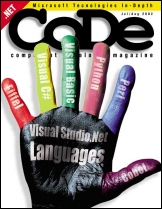
This issue saw a major overhaul in our internal production methodologies. New layout and art people were added to our lineup. The cover was one of the most memorable CODE ever produced (we call it the “6-finger wave”). However, many readers never noticed that there was one finger too many. Others said there weren't enough fingers. In particular - the lack of a C++ finger in our lineup of programming languages caused one reader to write and indicate his intent to show us a particular finger of his own. “Visual Basic finger in this case” as he stated. This brought about a major discussion as to which finger he really meant to show, considering there were six of them, and no-one really knew what it meant to show someone the 4th finger from the right. The content of this issue was top-notch. Many of the articles about individual programming languages had been written by Microsoft developers and product managers. At CODE Magazine, we generally welcome Microsoft employees to write when they have something important to teach. This issue, however, had an unusually large amount of content from Microsoft employees.
Nov/Dec 2002
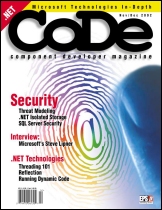
CODE Magazine wins its first major award! The security-themed cover design won us the silver (second) prize in the prestigious Maggie Zine Awards in the category of magazines with a circulation of under 50,000. Our additions to the layout and art department had started to pay off!
March/April 2003
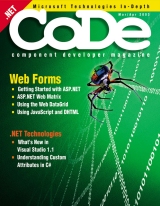
As time went on, we produced more and more .NET content until we finally moved into .NET almost exclusively.2003 was an important year in that regard. The March/April 2003 cover produced another Maggie Zine Award, this time we finished third in the category of magazines with a circulation of under 100,000 copies.
CODE Focus
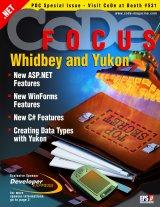
2003 was also the year when CODE introduced a new brand: CODE Focus. Under this brand, we published (and still publish) special issues focusing on specific technologies or topics that might be too specific for the general audience. At the 2003 PDC for instance, we shipped a Focus issue for Whidbey and Yukon technologies and were therefore among the first to provide in-depth information about these technologies. Other CODE Focus issues covered Office System 2003 development and Visual FoxPro 8.0 (since the language was not covered much in the regular magazine anymore).
Jan/Feb 2004
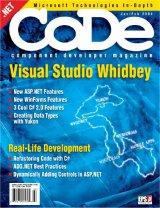
In early 2004, .NET's market share had grown so large that very few readers ever asked about content for older technologies any more (book publishers had also stopped covering pre-.NET technologies). .NET had achieved “critical mass.” The emphasis on .NET content also gave us the ability to do what we like best: We were able to shift our focus a bit from introductory topics to more detailed and in-depth articles, yet still remain relevant immediately to the majority of our readers. We also continued to take some first peeks at upcoming versions of Visual Studio (“Whidbey”) and SQL Server 2005 (“Yukon”). It is always important to know future direction, but we are also very careful to keep the majority of our content relevant for current technologies.
May/June 2004
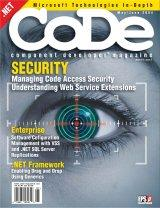
We have always been passionate about security. This time we decided to dedicate an entire issue of CODE Magazine as well as some online-only content to this subject. A move that resulted in one of our most controversial issues ever. “Finally, an eye opener,” one reader told us. But not everyone agreed. One article's suggestion that every single line of CODE has a certain level of security and it was the developer's responsibility to keep that level as high as possible resulted in more negative e-mail than we had ever received before. “Preposterous!” one reader declared, “Microsoft needs to fix security for me!” he continued. Oh well. We still have a ways to go on this subject.
Sep/Oct 2004
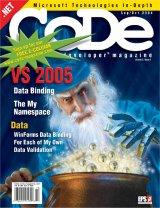
Another award! Yeah! This time we really knocked some big guys off the throne. Our cover showing a robotic wizard ("with a freakin' laser beam coming out of his eye") brewing up a Windows and Visual Studio 2005 potion beat all other magazines in the entire publishing market and won the2004 Gold Maggie Zine Award for publications with a circulation of up to 100,000copies. This feat is practically unheard of for technology publications, and better yet, CODE Magazine has won an award every single year throughout its newsstand life. This is a major milestone for us since we had now been awarded a hat trick from the publishing industry, and an outstanding content rating (4.18 stars average as mentioned above) from our readers. The best of both worlds!
Nov/Dec 2004
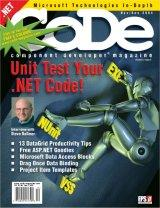
Steve Ballmer (Microsoft's CEO) has a lot on his plate. Nevertheless, he took a sizable chunk of his time and devoted it to an interview with CODE Magazine in the Nov/Dec 2004 issue. A feat other developer magazines still envy us for even today. Also, the cover art contains an Easter egg of sorts: The artist changed our robot's gender at the last second without letting us know, and we only discovered it after the magazine went to print. This sort of started a bit of a tradition in the recent covers. Many of them have their own little secret, hidden details, or subtle trivia attached. Can you find them in the early 2005 covers?
Where to Next?
This is an interesting question! “More of the same” would be the easy answer, but not so! Interesting changes are on the horizon, and the publishing world is changing. While we will keep doing what we have been doing in print, we will also step up our online content over the next months and years. We expect Windows “Longhorn” to have a major impact on the publishing business, and we intend to push the envelope in that direction. RSS feeds have already changed the world, and CODE is among the first publications to provide an RSS feed for its site. But we will also take that technology to the next level very soon! Stay tuned.
Did You Miss An Issue?
You do not have all the back issues of CODE? Not to worry! You can still order back issues for almost all issues online (www.CODE-magazine.com). You can also order our new content CD, which gives you indexed access to all five years of CODE Magazine. Don't miss out!